Paper
Timeline-Bench: Evaluating Agents on Realistic Video-Editing Tasks, from Raw Footage to Final Cut
Anonymous authors · Under review at ICLR 2027
Code and tasks: an anonymized mirror of the repository for review, at /code.
TL;DR
Timeline-Bench asks agents to turn raw production material and a brief into a finished video across 56 real editing tasks; the best of 16 agents resolves 15, and most unresolved runs pass every test but the quality test, which is calibrated on blind judgments by professional editors.
Abstract
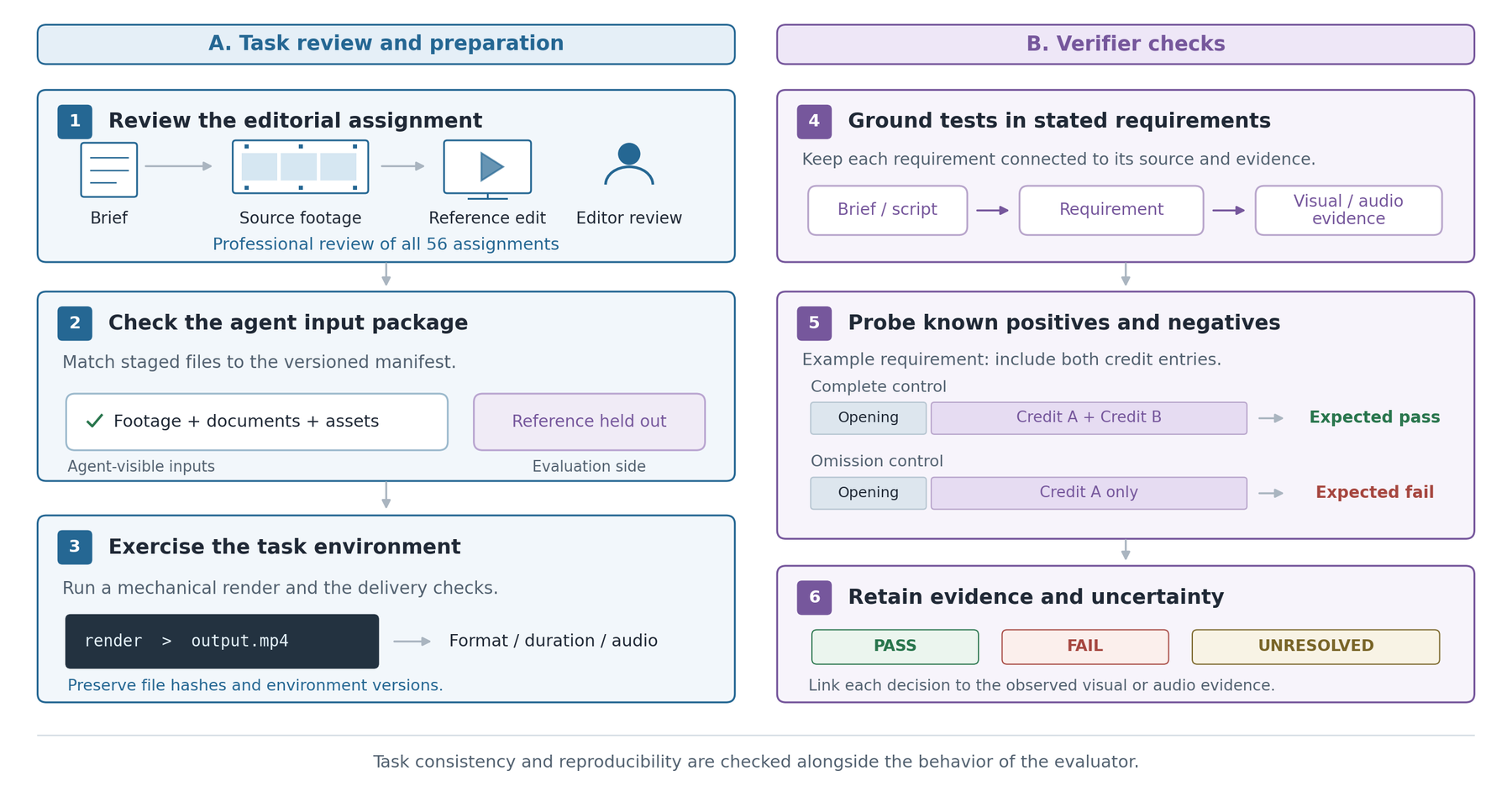
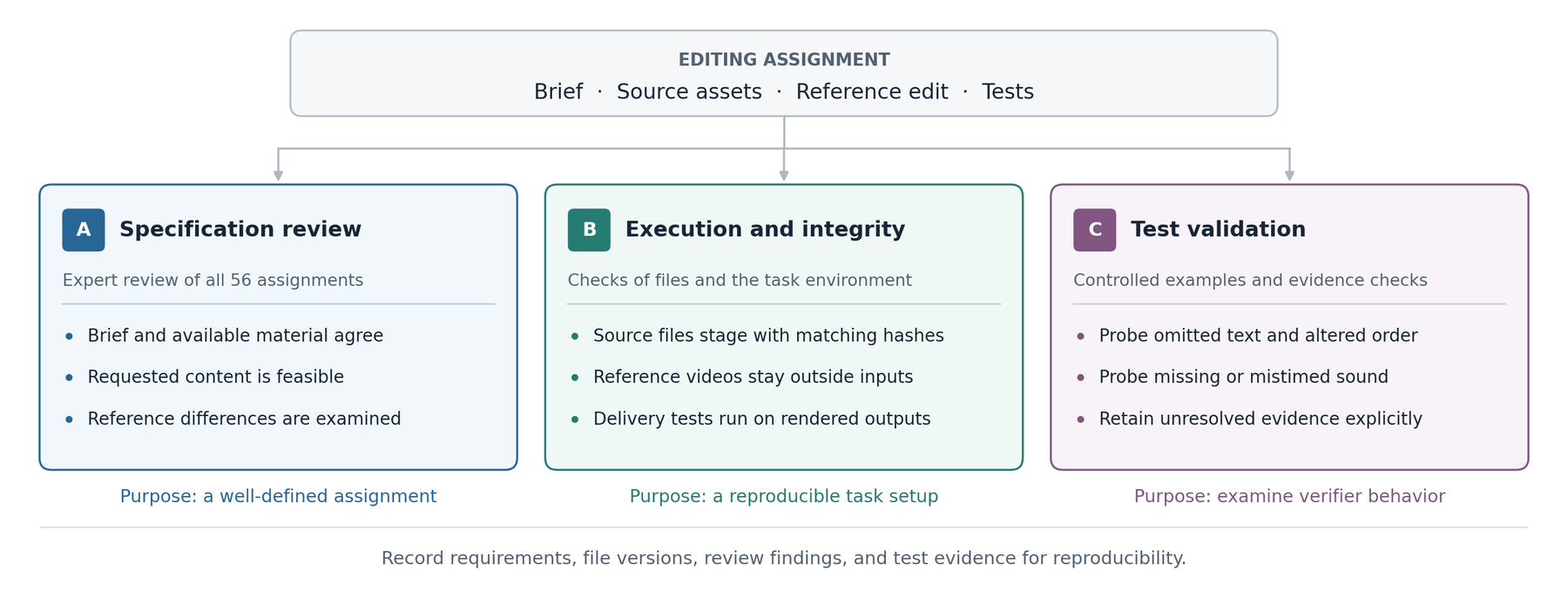
AI agents increasingly carry out long-horizon professional work, but their evaluations rarely require a finished creative deliverable. To this end, we introduce Timeline-Bench, a benchmark of 56 real video-editing tasks, each asking an agent to turn raw production material into a finished video. Tasks range from selecting dialog takes and shaping interview footage into a story to cutting commercials from product shots, voiceovers and graphics. Every task provides a brief, source assets, a container and a set of tests. A task is resolved when the output passes every test. The tests check the delivery format, the content and the brief’s explicit requirements, and include a quality test calibrated on 2,582 blind judgments by 43 video editors.
We evaluate 16 agents that pair frontier models with coding-agent harnesses such as Codex, Claude Code and OpenCode. The best, GPT-6 Astra in Codex with curated editorial guidance, resolves only 15 of the 56 tasks (26.8%), and the average agent resolves 14.0%. Human editors prefer the reference edit in 83.5% of judgments. Most unresolved runs (562 of 771) fail only the quality test: agents perceive footage through stills and transcripts and check their renders for defects, not craft. We release the tasks, verifier and per-run results at https://timelinebench.vercel.app.
- video editing
- AI agents
- multimodal benchmarks
- agent evaluation
- human preference
- editorial quality
Key numbers
- Tasks
- 56
- 4 collections, 5,003 frozen input files (672.7 GB); source packs are not distributed; no footage published
- Runs
- 896
- 16 agents × 56 tasks, one run each; 863 videos delivered
- Resolved
- 14.0%
- 125 of 896 runs, exact 95% CI [11.7, 16.4]; best agent 15 of 56
- Editors
- 43
- 2,589 blind judgments; the reference edit is preferred in 83.5% of the 2,582 assessable
Figures
Cite
During the double-blind review period the author entity is anonymous; the entry will be updated after review.
@inproceedings{anonymous2026timelinebench,
  title     = {{Timeline-Bench}: Evaluating Agents on Realistic Video-Editing Tasks, from Raw Footage to Final Cut},
  author    = {Anonymous},
  booktitle = {Submitted to The Fifteenth International Conference on Learning Representations},
  year      = {2026},
  note      = {Under review}
}
To cite a benchmark release, see Citation.